
Throughout my life, I have struggled with letters, numbers, lefts, and rights. I have both Dyslexia and Dyscalculia. Many people see it as a defect or a disability, often treating those who think and see things differently as less intelligent. I have learned to see it as a different way of thinking and seeing the world. I believe it is why I excelled at art, sewing, woodworking, and a variety of other things. Quite often, I tend to see patterns, angles, and spacing easier than letters and numbers.
The definitions for both of the Dastardly Ds according to the British Dyslexia Association, are below:
Dyslexia is a learning difficulty that primarily affects the skills involved in accurate and fluent word reading and spelling. Characteristic features of dyslexia are difficulties in phonological awareness, verbal memory, and verbal processing speed.
Dyscalculia is a specific and persistent difficulty in understanding numbers which can lead to a diverse range of difficulties with mathematics. It occurs across all ages and abilities.
I struggled as a student, I had to work twice as hard to compensate for something I couldn’t explain.
When learning to write, the letters p, q, d, and b were my absolute enemies. Learning numbers, I hated the numbers 6 and 9, 3 and 8. I remember being in 3rd grade and learning about time. When they asked me to draw a clock I drew it backwards, over and over again. I didn’t understand why they didn’t see it the same as me. It was 1973 in rural Kentucky, and my teachers, at the time, didn’t quite know how to help me. It wasn’t until I got a Goofy watch in high school (that ran backward) that I could tell you what time it was without making my head hurt.
I love literature. In 5th grade, my teacher read to us every day. I loved that time of the day. I easily got swept away in a story and it is why I love telling stories now.
But, I hated the time of the day when she made each of us read aloud. I often read lines backward, from the bottom of a paragraph to the top, or skip lines completely. I had to hand it to her, she was patient with me, even though it took me twice as long to read and comprehend as everyone else in the room. She let me work it out. My classmates were not as understanding. Still, through all that, I developed a love of the written word.
In high school, typing was a struggle and I barely passed the class. When computers took over the world, around 1986, I was determined to overcome my fear of the keyboard. The struggle was getting the written word into text on a screen. I found that typing from memory or audio was much easier for me. I didn’t have to think about what I was seeing, the muscle memory, knowing where the keys were did the work. The last time I took a keyboarding test, I typed around 80 words per minute without mistakes.
Because of the dyslexia, I developed terrible test anxiety. Because of the dyscalculia, I had a horrific time with math, and algebra was a nightmare. So, those scholastic tests would make me physically ill by the time they were over. Dyslexia also makes it hard to learn foreign languages, as both my high school French teacher and my bonus daughter in Germany can attest.
I found it interesting that I excelled in geometry, because of its visual nature. I did well with drafting and art because I could visualize space and understood color blending. I am mechanically inclined because I can see how things fit and work together.
As an adult, it took me a long time to be comfortable knowing I was different. I became a life-long learner, avid reader, and a bit of a techie nerd. To learn something I wanted to know I had to be ok with reading slower to comprehend, to absorb more. I learned that I had to pay closer attention to the details and to what was going on around me. I found out that I am not alone. Many people struggle like me. I also learned that many dyslexics have strengths in other areas, such as design, problem-solving, creative skills, interactive skills, and oral skills, people like the Wright brothers, Einstein, Richard Branson, and Cher. Not bad company to be in.
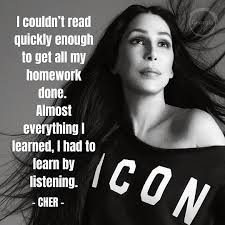
Over many decades, I learned ways to work smarter and play to my strengths. When I was younger and worked in a screen printing shop, I could read the negatives, upsidedown and in reverse, and often caught things before they went to press.
I have learned to navigate in a world that expects everything in an instant. I have never been one to let someone tell me I can’t do something. I know my strengths and I know my weaknesses. Life is about learning to play to your strengths.
I still struggle at times and I still get test anxiety. Challenges can loom over you like a dark cloud, I know to pay extra attention especially when I am nervous, hurried, or tired. Occasionally when all three take place at once, it creates a perfect storm for me, and I shut down. I will deflect it with humor or bite back with anger. Knowing that about myself helps me be aware, so those instances happen less often. But it still happens.
Most people would never know about my dyslexia or dyscalculia unless I shared that information. My point is, that you never know what someone else’s struggles may be. It is easy to become impatient with people when you are in “go” mode and the world demands things instantaneously. It is often harder to offer grace to something you don’t see or understand. Be kind in a world that is harsh.
 On a Roll with Charmin